Showing posts with label Power Tools. Show all posts

Monday, August 31, 2015

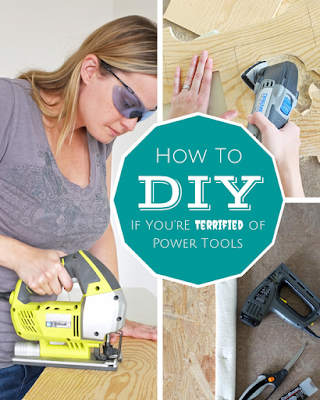
How to DIY Even If You're Terrified Of Power Tools


Cheap Power Tools For Sale
Maybe you're not terrified of power tools, but they scare you a little, they intimidate you, or you just plain don’t like using them.

So, what do you do when you want to DIY a big project that requires power tools?

How to DIY When You’re Terrified of Power Tools

1. A tool is just that, a tool.

A means to an end. When it comes to tools there is the hard way or the easy way. The hard way is hand tools. They don’t make any noise, other than your grunting. They don’t require a plug or batteries. And they are far less scary. But the sweat equity you have to put in is what makes it the hard way. Then there's the easy way. It costs more upfront, still scares you a teeny bit even after a dozen uses, and the battery dies at the most inconvenient times. But power tools help you get tough jobs done quickly, more precisely, and with a lot less sweat (if we disregard nervous sweating).

2. Safety First

If power tools scare you, the best thing you can do is get comfortable before using them. Knowing how to operate a tool and understanding all of it's safety features will make you feel more at ease.

    *Read the manual cover to cover. I know you want to skip it, because all the warning signs and hazard symbols make you nervous. But those are the parts you should pay special attention to. The manufacturer has to warn you, but it doesn’t do any good if you don't read and understand the manual.
    *Take a free class or demo. Most home improvement stores offer free in-store workshops and demos, so you can learn about and try a new tool with an expert by your side. Seeing a demonstration, which will always include a safety segment, and getting to try a tool out in a low risk environment helps a lot.
    *Have a skilled friend or family member show you how to use a tool. Almost everything in the world is less intimidating if you've seen someone else do it first. Unlike seeing a tool on TV or YouTube, you can see, hear, and feel how the tool operates first hand…without volume control.

3. Don’t Do It Alone

Aren’t most things you are scared of our don't like better when you have someone else there with you? I personally feel a gazillion times safer when I am not alone with power tools.

When you need a break pass the sander to your friend. Give yourself a rest long enough for the sander-holding hand to stop shaking and get sensation back in the finger tips.

A second set of hands can also help you hold larger stock pieces, take over for a while and give you a break, and just be all around emotional and motivational support for the project you’re tackling.

With two or more people, take the Henry Ford approach…assembly line, baby! It won’t work for every project, but when it does work, it makes everything go by a lot faster.

    Set up stations for each of the tools needed for the project. Bonus points if you have a different person to man each station.
    Make all measurements (and double check them first).
    Make all cuts or pre-drill all holes at once.
    Install or assemble all the ready pieces.

4. Practice, Practice, Practice.

I know I made some mistakes early on which made me hate my tools more, because of the costly materials they I ruined. I should have started smaller and cheaper. Don't make your first cut with a saw on a piece of your new hardwood floor. Don't buy the best wood possible to make your first piece of furniture. Don't use a power nailer for the first time in a visible area that can’t be patched.

I love, and should have followed, Ana White's advice on getting starting. She recommends buying the cheapest wood available. She also has a set of “starter projects”.

Practice small to build up your confidence and skills before investing in good materials and tackling more complicated projects.

5. Get someone else to do it.

This is not wimping out. This is being realistic and true to yourself. If you hate power tools or still don't feel comfortable with them, get someone else to do the dirty work for you.

Here's 3 popular options:

    Have the hardware store make all your cuts at the store. Make sure you bring detailed and accurate measurements. Understand the store's cut policy. Some may charge per cut or limit the number of cuts they will make.

    Have a friend or family member do it for you. When I installed the cork floors in my basement, I did everything myself. The entire time I reminisced about installing the bamboo floors in my last house. we set my dad up in the garage with the Electric Saws. We measured and installed, he made every cut. We had another family member running planks up and down the stairs to the garage.

    Hire a handyman to do the work you don’t want to do. By DIYing part of the project and getting expert help on other parts, you can still save money over a completely done-for-you solution. We did this on a large scale in our basement. We opted for a semi-DIY approach to basement finishing. We contracted all plumbing, electrical, framing, and drywall. Leaving the stuff we didn’t mind doing, like installing light fixtures, painting, and installing flooring and trim.

Bottomline, if it's not for you, it's not for you. Just don't do it. Large builds are out for me. After a few failed attempts at building my own furniture from scratch, I am saying no to larger furniture projects, and that's okay. There are plenty of alternatives, starting with the tips above.

Thursday, August 20, 2015

Must-Have Tools for Beginning DIYers


If you've realized how incredibly expensive home improvement projects and furniture can cost, you have probably also realized just how much you can save by becoming a "do-it-yourselfer."  If you want to start DIYing your home and furniture projects, Remodelaholic is a great place to start!  The good news is that to become a DIYer, you don't have to have a fully functioning shop like you see on popular TV shows. You need a few basic tools to get you started.  

Bear in mind that every home should have good tools, but you do not need to buy a ton of expensive tools all at once. It is best to acquire quality tools as you need and can afford them. As a general rule, it is best to invest in well-made items that will last a lifetime.

With that in mind, here are the 10 tools we recommend to get you started on your DIY path:


three layer Metal toolbox tool storage box iron tool cabinet professional repair electrical tool box

1. A toolbox
A toolbox.  You will need a toolbox or tool bucket to keep your tools organized.  The more organized you are when tackling a DIY project, the more successful you will be.  Nothing will slow you down more than poorly organized tools!  Toolboxes range from large to small and portable. 

Multifunctional manual tool household portfolio hardware tool sets


2. Basic hand tools
You need basic hand tools, such as a hammer, pliers, screwdrivers and a utility knife!  There are some fabulous basic toolkits that you can buy to get you started quickly and easily.

18V 1500mAh Hand Cordless Drills Screwdrivers with 2pc Li-batteries 


 3. A cordless drill
The first power tool any DIYer should invest in is a cordless drill.   Cordless drills are convenient for working anywhere.  They not only drill holes and drive screws, but, with different bits, can stir paint and materials like thinset and concrete. 


DEWALT 2.4 AMP 14000OPM Durable Longer Life Sheet Palm Sanders


4. An electric random orbital sander.
All DIYers find themselves sanding...a lot.  To avoid doing it all by hand, you will need an orbital sander.  They are not very expensive, and are worth every penny.


DEWALT 1200W 5500rpm 48° 184mm Accurate Cutting Compact Circular Saws


5. A circular saw
As a DIYer, you will find that there is no saw that is more versatile than a circular saw.  It can take the place of a table saw, if you use it in a conjunction with a straight edge. 


Aluminum Angle Slope Finder Laser Level Spirit laser Level 200mm


6. A level
From hanging pictures to building furniture, you have to make sure your work is level.  So, to start with, we would recommend a 9 inch level.  As you continue down your DIY path, you will eventually want a 24 inch level as well.


7. A 6-inch combination square
A 6-inch combination square is so versatile.  In addition to using it to check for square, you can use it as a straight edge when you are cutting 2 x 4s or 2 x 6s.  It is also an excellent marking tool--you can use it to mark things like angles and the position of hinges.


8. A stud finder
A stud finder.  Hanging something heavy?  You will need to secure it to a stud in the wall in order to avoid disaster.  A stud finder will help you find your studs so that you can safely secure shelves, cabinets, expensive TVs, etc. to your wall. 


Professional Heavy Duty Pneumatic Tapler, Air stapler Staple Gun, Pneumatic Nail Gun


9. A staple gun
Staple guns are inexpensive but are incredibly versatile.  You can use a staple gun for everything from upholstery to making a simple greenhouse with a wood frame with plastic sheeting stapled to it. 


10. A putty knife
A putty knife.  Last on the list, but certainly not least, is a putty knife.  The putty knife, of course, is routinely used for spreading putty when patching holes in walls.  But it can also be used to scrape off old paint or glue residue, pry up nails and remove wallpaper.  You may want to start with a set of three putty knives for the most versatility.

With these tools in your arsenal, you will be an unstoppable DIYer in no time!  Looking for more power tools, hand tools, measuring tools at www.eastmachinery.com.

Wednesday, August 19, 2015

Build A Rope Wall


I've been helping out Shelly Leer – aka ModHomeEc – with the design of her brand new upholstery workshop in Indianapolis. Shelly is a fantastic upholster and hosts classes to teach folks the ins and outs of fixing up and reupholstering their old forlorn stuff (a skill I can really appreciate).

With this open warehouse space, one big design issue Shelly needed help with was figuring out how to layout and define areas for various work and private “zones”. She needed areas for tools, areas for storage, an area for a personal office, a waiting area, an area to teach and work with students and so on and so forth. Functionally, this one big room had to be used for many many purposes and still be open, accessible and of course look awesome.

Since cost is always an issue (and this space is a rental), it wasn’t prudent to dump a bunch of cash into building traditional solid walls that would split up the space and make it feel smaller and darker. My solution was to build these vertical jute rope division walls that allowed for defined “zones” but still retained light and visibility throughout the entire space. A plus when using this type of jute rope is the added benefit of bringing in a chunky / graphic / warm texture to an otherwise cold and hard industrial room.
Power Tools For Sale


The construction process is pretty simple. Wood boxes were custom built with evenly spaced rope sized holes drilled through the top and bottom. Precut sections of rope were strung through the top and tied off at the bottom, allowing for the interior knot to hold the rope in place and taut. Just screw close the open side of the box and all those ugly knots are hidden away.

With this design the overall costs are kept pretty low for such a big impact. Rope is cheap, especially when bought in bulk, and wood boxes are very low cost to build. The true cost is going to be labor and time – it’s just a tedious and super repetitive process.


Come on. Hotness.

I think the outcome is pretty spectacular. Not that I’m bias or anything.


This roped off area is actually Shelly’s office!

I’m completely thrilled with how these rope walls came together and so happy I didn’t have to lift a finger and do any of the actual labor. There is another wall in the works that I’m pretty excited to see completed as well as other awesome ideas that came from designing Shelly’s new workspace to be affordable, functional and downright ‘effing stylish.

Looking For Cheap Power Tools Sale on www.eastmachinery.com

Friday, August 14, 2015

How to Build a Desk Out of Cabinets

How to Build a Desk Out of Cabinets With kitchen remodels happening all the time, many old cabinets are either thrown away or donated. Instead of tossing them out at the thrift store, repurpose them into a portable desk for your elementary-aged child. This desk provides a large work surface, a chalkboard, a storage compartment for papers and books, as well as holders for all kinds of school supplies.

Things You'll Need

*Phillips screwdriver
*Needle-nose pliers
*Measuring tape
*Circular saw
*Cabinet with one door and one drawer
*Mallet or hammer
*One-by-three pine board, 100 inches or enough for perimeter of cabinet face
*Cordless drill/driver
*Pocket hole joinery system
*Wood glue
*1 1/4-inch pocket hole screws
*1/4-inch plywood, cut to dimensions of cabinet face
*1/2-inch long nails (if using nail gun, use 18 gauge)
*Pneumatic or electric nail gun (optional)
*Pencil
*Small plastic cups, 4
*Self-feed drill bit, 1-inch diameter
*Jigsaw
*Wood clamp
*Wood filler
*Sandpaper, 150 and 220 grit
*Orbital sander (optional)
*Router with router table (optional)
*1/2-inch core-box or round nose router bit (optional)
*Cabinet knob, 1 (optional)
*Table leg straight top mounting plate, 2 1/2 inches wide, 4
*Wooden furniture feet, 4 inches tall, 4 (can use taller feet, depending on preference)
*2-inch paintbrush
*Paint + primer latex paint, white, semi-gloss
*3-inch foam roller brush
*Chalkboard paint
*Small tin buckets, 4
View or buy these items on Eastmachinery.com

Step 1: Disassemble the Cabinet

Using a mallet or hammer, remove the back of the cabinet from the cabinet face. If drawer slides are attached to the cabinet face inside the cabinet, remove them with a Phillips screwdriver. Use the mallet to loosen the sides and bottom of the cabinet from the cabinet face, as well as the drawer sides and bottom from the drawer face. Needle-nose pliers may be used to remove any staples. Remove pulls or knobs with a screwdriver.


Step 2: Build the Desk Base

Measure the length and width of the cabinet face. Using a circular saw, cut a one-by-three pine board into two long pieces that are equivalent to the length of the cabinet face and two short pieces that are 1 1/2 inches shorter than the width of the cabinet face. For example, the cabinet face used in this tutorial is 31 inches long and 21 inches wide. Two boards were cut at 31 inches and two boards were cut at 19 inches. Adjust these measurements depending on the size of your cabinet face.

Drill 3/4-inch pocket holes along the long pieces of wood, spaced about 4 to 5 inches apart. Drill 3/4-inch pocket holes along the long side of the short pieces of wood, and then two pocket holes on either end. Use wood glue and 1 1/4-inch pocket hole screws to screw the short boards to the inside of the long boards so that a box is formed.

  
Step 3: Attach Desk Base to the Cabinet Face

Using 1 1/4 inch-pocket hole screws and wood glue, attach the desk base to the underside of the cabinet face. Work slowly and do not drive the pocket hole screws too deep so they poke out the other side. Then cut a piece of 1/4-inch plywood to the same dimensions as the cabinet face and attach it to the underside of the desk base with wood glue, 1/2-inch nails and a hammer, spacing nails every 3 inches along the perimeter. An optional alternative to the hammer and nails would be to use a pneumatic or electric nail gun and 18 gauge 1/2-inch nails.

Step 4: Make Holes in the Drawer Face

Using cups or small tin buckets as a template, trace four evenly-spaced circles on the drawer face. If tracing from the base of the cup or bucket, draw the circle about 1/2 inch larger than the actual diameter. Drill holes along the edge of the diameter of the circles with a 1-inch self-feed drill bit, and then use a jigsaw to slowly cut along the perimeter of the circle. Repeat for the remaining three circles.

Tip
While drilling holes and cutting circles in the drawer face, a large (3 inch or thicker) piece of polystyrene can be used to work on top of. The polystyrene will not affect performance of the jigsaw and is sturdy and hard enough to provide adequate support to the drawer face while making the cuts.


Step 5: Attach Drawer Face to the Cabinet Face

Place glue along the underside edges of the drawer face and carefully position it on top of the cabinet face over the drawer opening. Use a measuring tape if necessary to make sure placement is even on all sides. Clamp the drawer face to the cabinet face and let it dry overnight.

Step 6: Attach Knob to Cabinet Door or Route the Edge

If the cabinet door sits flush with the cabinet face when closed, a knob will need to be attached to easily open the desk. Measure, mark and drill a hole in the center long edge of the cabinet door (the unhinged side) so that it will not interfere with left- or right-handed children. Attach the knob.

Another option is to route the long edge of the cabinet door so a lip is formed for easier opening of the desk. To do this, position the router table guide at 0 inches so half of the round nose bit cuts into the edge of the door. Remove the screws from the hinges on the cabinet door and slide it along the router table, following the manufacturer's instructions. Once the door has run through twice (to ensure an even cut along the entire long edge), sand the cut edges with 220 grit sandpaper to remove splinters.

Step 7: Fill Holes and Sand the Desk

Use wood filler to fill the holes from the cabinet pull, seams and places where the desk base join with the cabinet face. Let it dry for several hours. Sand the pre-finished cabinet door, drawer and base with 150 grit sandpaper by hand, or use an orbital sander to remove the protective finish and make it easier for paint to adhere to the surface. Sand the areas where wood filler was used and all edges with 220 grit sandpaper to ensure there are no sharp corners or splinters.


Step 8: Attach Feet to the Desk

On the four corners under the desk base, mark and pre-drill holes for the table leg straight top mounting plates. Attach the table legs into place using the screws provided with the mounting plates. Be sure to screw in the legs until tight. 

Tip
A hole for the inside corner of the plate does not need to be drilled, as it is not needed for stability and the screw would puncture through the other side of the plywood, making a sharp point coming through the inside of the desk.


Step 9: Paint the Desk

Use a 2-inch paintbrush and white latex paint + primer in semi-gloss finish to paint the entire desk, except the center of the cabinet door. Apply two coats and let dry completely. Use a 3-inch foam roller brush to paint the center of the cabinet door with chalkboard paint. Apply two to three coats and let the desk dry for 24 hours.


Step 10: Place Small Tin Buckets in the Holes

Place small tin buckets or cups in the four holes that were cut out earlier, and fill with crayons, pencils, chalk, scissors or other school supplies.

Tip
To season the chalkboard before use, fill in the entire chalkboard surface with white chalk and then wipe off. This prevents marks from first-time use from remaining visible after being wiped away.

This desk provides great storage for all school supplies, keeping it organized and accessible. The sturdy surface and solid construction will last for years, while the portability means it can be used on the floor, sitting on a couch, or in a bed.

Wednesday, August 12, 2015

DIY Home Improvement Excuses Are No Longer Going To Hold You Back From Doing Good Work

Some believe a home is always an unfinished project. Some homeowners have the enthusiasm to make the home perfect whereas some rely on excuses to not take up DIY home improvement projects. The fact is people who give excuses are just finding ways to postpone these projects. It is fine to postpone some projects, but there may be a few tasks that need immediate attention. For example, if a nail is sticking out of a cabinet, or a chair has a loose leg or a shelf is drooping on one side or a pipeline is clogged. Such tasks need to be tackled at the earliest and there is no reason to avoid them.

If you still managed to come up with the classic three excuses, we have the answer to all three of them:

“I lack the talent to do justice to the task at hand”

Not having experience at some activity has never stopped you from trying things out in the past.  Be it trying out some new food or learning some new sport. DIY projects are exactly the same. You may not get them right the first time, but there is always room for improvement. You can keep taking up new projects to improve your skills. After all, only practice makes one perfect.

These days, a lot of tutorials are easily available online, all thanks to the latest advancement in technology. Some of them are illustrated through photographs, whereas some even have videos. All you have to do is understand the task and try it on your own. It is really not about the talent. It is more to do with being patient and showing perseverance. As you practice your skills, you get better with experience. If you feel DIY household projects are meant for crafty households, then you are mistaken. It is for everyone and anyone who shows interest.

“Where do I get the time from?”

You don’t get time; instead, you have to make it. We agree, some DIY household projects may take up more time than expected but most projects are small enough to be tackled over the weekend. To save up on time, you can understand the project over the week and watch some tutorial videos as well. Next you can even keep the materials ready so that on the day that you actually undertake the project, you can finish it in the least amount of time. Furthermore, you can always ask your family to help you out. If you get stuck with something, you can go online and ask for help from DIY communities.

“I have a budget constraint”

If you are tight on budget, it even makes even more sense to take up handy, crafty DIY household projects. Rather than calling in a handyman, you can do it yourself and save a few bucks. Also, if you tackle the repairs from an early stage, you can avoid bigger expenses in the future.

Complaining about investing in a lot of tools isn't fair. You can make smart choices by purchasing an oscillating tool that can perform multiple tasks. Multiple usage cheap power tools sale can do all those jobs, which would otherwise require five to seven different tools. Thus, it is all about buying smart tools and borrowing the rest from friends.

So now that all your excuses have been taken care of, you have no reason to actually not take up a good DIY project. Get the gears rolling and plan your next project well in advance so that you have something good to show to everyone around you.

What Tools are Women Looking for Today?

The popularity of the Home & Garden TV Network (HGTV) and the Do It Yourself Channel (DIY) demonstrates how many women are taking on home improvement projects, and not just the easy ones.   Women have become much more adept at using cheap Power Tools for sale, air tools, all types of saws, and even plumbing and electrical tools.   Tools are an important aspect of women being able to handle these renovation projects and complete them like a “pro”.   Besides watching television shows, many women are seeking the assistance of the local home center or hardware stores, and consulting friends or reading books, in order to improve their skills.
Women with Electric Drills

When it comes to retailers, shopping in a home improvement center was described as “easy” by nearly one-third of respondents, while one-quarter deemed it “more fun than food shopping.”   Home improvement stores received high marks for their marketing efforts and treatment of women; with 64% of respondents saying the stores did a good job overall. Home improvement stores like Lowe’s and Home Depot are getting in on the action by providing in-store workshops to women. These workshops demonstrate what materials and tools are needed for how-to projects. Television programs and workshops help women become more knowledgeable about tools so they know what items to purchase.

This year (2011), Home Depot is recognizing that while women may be half of its customers, it has not catered to them in ways that translate into a larger market share.    ”People are starting to spend more money again, and we need to participate in that,” said Gordon Erickson, the senior vice president for merchandising and décor at the Home Depot.

“For years, we’ve always had a bad — I don’t want to say a bad reputation, it’s more that people look at our business and think it is male-oriented, dominated,” Mr. Erickson said. “Fifty percent of our customers are female. We need to offer her products that she wants.”

Because of the accelerated interest women have in becoming “do-it-yourselfers”, lines of tools have been created specified to fit them more comfortably.    Some tools designed for today’s women include:

    16 oz. curve claw hammer with a smooth head. This all-purpose hammer is not too heavy on a woman’s wrist, but heavy enough so a woman can do the job right.
    25-foot tape measure. Its width makes it easy to read the numbers and it doesn’t bend when pulled out a few feet.
    10-inch tongue-and-groove pliers. This tool easily controls plumbing fittings and nuts.
    Retractable utility knife with blade storage in the handle. This tool is used for cutting everything from vinyl tiles to drywall. The blade is easy to replace and stores in the handle for safety.
    Ratcheting discount Electric Screwdrivers online with multiple bits. The multiple bits change out easily, depending on if a small or large Phillips or a slotted head is needed. The ratcheting action allows you to keep a steady pressure on the head of the screw while simply twisting the handle in place.

Monday, August 10, 2015

Women Are Making Their Mark on Home Improvement

Women have made their mark in the world of home improvement and repair.   Today, inverter for power tools are being developed that make women feel inspired and empowered.   This is a direct result of the number of women who have taken on their own home improvement and rennovation projects, and who are purchasing home improvement products.   The Wall Street Journal reports that women are buying 61% of major home fix-up products and, according to Forbes, women initiate 80% of all home-improvement purchase decisions, especially when it comes to big-ticket orders like kitchen cabinets, flooring and bathrooms.

Overall, women account for more than $70 billion worth of purchases in the home improvement industry, up from $55 billion in 1995 (according to a recent survey by the Home Improvement Research Institute).  This rising trend is due to women tackling home repair projects on homes they own themselves. In fact, within the first year of home ownership, women spend almost $9,000 on home improvement projects. Contributing to the growing trend of women purchasing cheap power tools sale are home improvement shows and hardware stores catering to women shoppers.

“Women are very influential and powerful consumers when it comes to home improvement projects around the house,” said Rob Cappiello, industry vice president of the National Hardware Show. “In addition, single women are purchasing new homes at twice the rate as single men, which contributes significantly to their increased involvement in do-it-yourself home improvement projects.”

Single women are now the second-largest group of home buyers in the U.S., after married couples, according to the National Association of Realtors (NAR). Women are now responsible for 21% of home purchases, says the NAR, and at the end of 2010, women-headed households   represented approximately 28% of the U.S. total, or 31 million.

What Renovation Projects Interest Women?

Although many people still consider home improvement projects to be a man’s job, three-quarters of American women ages 25 to 49 say they are doing more home-improvement projects today than five years ago, and a solid 80% plan to tackle at least one home-related project in the next year.  In a national telephone survey conducted by Opinion Research Corporation on behalf of Scott Towels by Kimberly-Clark, the #1 reason women took on home improvement jobs was to save money.   Personal pride and satisfaction was the second most important reason.

Hands-down, the most popular home improvement projects for women are:

    Painting                                                                      86%
    Bathroom remodeling                                               38%
    Wallpapering                                                             35%
    Plumbing                                                                   30%
    Kitchen remodeling                                                   29%
    Tile work                                                                    28%
    Additions or renovations                                           27%
    Electrical work                                                            23%
    Laying carpet                                                              18%
    Window replacement                                                 14%

Friday, August 7, 2015

5 Power Tools That Changed How We DIY

You guys love to ask tool questions, and the truth is that it still catches me off guard that I’m The Guy People Ask About Tools. Some were the gateway drug (or saw). And most are now things that we can’t do without. So without further ado, I present to you: 5 Power Tools That Changed How We DIY.

12V Li-on Rechargeable Hand Cordless Drills Mini Electric Screwdrivers
#1 – Power drill / driver – I’ll start slow here, because a $40 cordless drill barely registers on the power tool spectrum. But my little 12v battery-operated drill/driver that I bought nearly a decade ago is still one of my best tool purchases. Just putting a little power behind the otherwise tedious task of screwing things together or drilling simple holes (like for picture hanging anchors) has made small DIY tasks much easier and faster. Seriously, just buy yourself a hex screwdriver bit set and see how much faster your next Ikea assembly goes. Here’s an affiliate link to one that’s extremely similar to the one we have by Black & Decker (our exact model is no longer available).


http://www.eastmachinery.com/product/718.html
#2 – Miter saw – Power saws were the most intimidating power tool to me. I mean, c’mon, there’s a whole gory movie franchise bearing their name. But borrowing my dad’s miter saw to install trim in our first bathroom remodel was eye opening to me. Just making simple 45° cuts turned out to be super easy, fast, and even kinda fun. I got that little rushthat  you get when you conquer a fear and it triggered a complete 180° in me. I love saws. I own six of them (not counting the manual ones). And becoming confident with them has opened up a whole world of projects we can tackle – whether it’s cutting big sheets of plywood with a circular saw or ripping floor boards on our table saw. Here’s an affiliate link to the exact miter saw that we have.

#3 – Kreg jig – Now this one isn’t technically a power tool (although it does involve using a power drill/driver), but it was too significant in my “tool journey” to leave off the list. This was the device that got me interested in building stuff. It took some of the mystery out of joining two pieces of wood together (not that there’s a whole lot of mystery there to begin with). I started small with some shelves for Clara’s nursery and before long we were using it to constructing giant console tables, play kitchens and even real kitchen cabinets (okay, all of those should probably be singular). Although I’ll admit ol’ Kreg and I don’t spend as much time together as we used to thanks to the next item on my list. Here’s an affiliate link to the Kreg Jig that we have.

Professional Heavy Duty Pneumatic Tapler, Air stapler Staple Gun, Pneumatic Nail Gun

#4 – Nail gun – After “saw”, “gun” is the scariest word in the tool dictionary to me. I was a slow adapter in purchasing a nail gun (we bought ours less than a year ago) and our model is far from heavy duty. But after hours of numb arms thanks to manually hand-nailing some crown molding in our last kitchen, I knew we had to up our game if we wanted projects like adding board and batten to take days instead of weeks to complete. And just like with the miter saw, within one use we were both full converts. Not only has it made projects like adding crown molding and installing our sunroom ceiling possible, but for the most part it (plus wood glue) has replaced a lot of tasks we had previously used the Kreg Jig for (mainly for speed reasons, since glue + nails is much faster than drilling pilot holes and screwing things together – although that’s still the best way to go for certain tasks). Here’s an affiliate link to the nail gun that we have.
Mini HVLP Air Spray Gun 1.4mm Furniture/Wood Automotive Primer Paint Sprayer Spray Gun

#5 – Paint sprayer – This is the latest power tool to join the Petersik ranks (it’s even newer than the nail gun) and it almost didn’t make the list. Just like numbers one through four, it has been invaluable for speeding up tasks that otherwise would’ve taken us days – namely spraying all of the blue/cream/mauve trim & doors on our house’s second floor before moving in. But it wasn’t a shoe-in for this list because I still have a love/hate relationship with it. While I love its painting speed, there’s a lot that I don’t love – from prepping and protecting against over-spray, to the time it takes to clean it after use – which means using it isn’t a no-brainer for us every time. I’m still glad we have it, and we definitely like to use it strategically (like for painting the kitchen cabinet doors that we could remove and spray in the garage while hand-painting the frames that were still in the kitchen to avoid an over-spray snowstorm), but it hasn’t caused us to ditch our old school brush and roller completely. Here’s an affiliate link to the currently sold version of the one we have by Graco.

So those are our 5 power tool game-changers. What are yours? Are there any others you think I should add to our repertoire?

Wednesday, August 5, 2015

How to Buy Power Tools for Women

power tools for sale
With more and more single women buying homes on their own, it has become necessary for them to learn how to handle their own do-it-yourself projects. When one owns a house, things break, and it is not always possible to hire a handyman. With that in mind, it is a good idea for women to have their own set of power tools. Although women can use power tools designed for men, those designed especially for women make a job easier. When looking to purchase power tools for women, it is a good idea to learn which ones are necessary, and where they can be found.

The Cordless Screwdriver or Drill
One of the most important and useful power tools for women is the cordless screwdriver, or a low-voltage cordless drill. Keep the weight of the battery in mind when judging the weight of a cordless screwdriver or drill. The low-voltage drill is an excellent choice for the do-it-yourself woman, because it does not weigh as much as more powerful, higher-voltage models. Try to find a screwdriver or drill with an accompanying bit or driver kit, which keeps bits and drivers organized neatly.

A cordless drill or electric screwdrivers can be used to drive screws, drill holes, or as a power source for other accessories, such as the paint stirrer. Some cordless drills feature a removable battery with a belt clip. Cordless drills and screwdrivers are very useful when assembling furniture, hanging pictures, or performing other simple handi-woman tasks.

Lightweight Sanders
DIY women should also consider purchasing one or more sanders. The detail sander and the orbital sander work together well in tandem. The detail sander can reach corners the other cannot, but the orbital sander is able to sand a larger amount of space at a time. Refinishing furniture, decking, trim, and much more can all be done with these two tools.

A mouse sander is also a good choice. It is a smaller version of the orbital sander and is terrific for accessing small corners and tiny spots that are difficult to reach. Since it is so tiny and easy to use (it fits in the palm of one’s hand), the mouse sander is perfect for crafts and smaller jobs. Some sanders even come with a dust bag attachment to catch any sawdust created in the process.

Power Saws

cheap Power Tools for sale
There are several types of power saws that any female do-it-yourselfer should find beneficial. The 18-volt circular saw is a great lightweight choice for doing odd jobs around the house. It has a built-in laser guide make sure that the cut is made in the right place. When straight cuts are needed, this tool would be the one to use. It is great for building bookshelves or cabinets, cutting closet shelving, and other such jobs.

The miter saw is a small but powerful tool, and is perfect for cutting trim and other small jobs. But it can also be used for cutting larger boards by simply flipping the board over and making a second cut.

Small circular saws are also available, and can do well on larger boards which may need cutting. Look for lighter weight circular saws, since they can be quite heavy and hard to handle otherwise.

The jigsaw is also a good choice, and can be the most versatile saw in the toolbox. The jigsaw is perfect for cutting drywall, plywood, trim, particleboard, and much more. Small projects are easy to do with this tool, which can make curved cuts that other saws cannot. You can find both battery powered and corded jigsaws, as is the case with many power tools.

 
Corded, or Cordless Power Tools?
When working on any type power tool project, it is important to use the most appropriate tool. As mentioned above, most power tools come in both plug-in and cordless varieties. Deciding which version to buy depends on the project..

Cordless power tools have both good and bad points. On the negative side, they rely completely on their battery, and so have a much less consistent, sometimes undependable source of power. Work may need to stop so that the battery can recharge before work continues. Over time, the charge length will deplete until eventually the battery must be replaced.

On the positive side, however, cordless power tools are much more convenient to use and can fit into tighter places than their corded counterparts. While the corded power tool has an unending source of power (unless the electrical service fails), its reach is limited to its cord length. Using an extension cord can remedy this somewhat, but hauling around a heavy cord can be wearisome, and it slows down the work of anyone using it. Another benefit of cordless tools is that they can be used even when there is no electric service. If the power is out, or if you are working outside of civilization, a cordless tool is your best bet.

The choice between cordless and corded power tools must be left up to the worker. Some may like the convenience and reach of a cordless, or may need to fit into tighter spaces without being tethered to a power source. Others may require a more powerful tool or the certainty of plug-in power. So the decision must be based upon the job itself, the needs of the user, and the availability of a power source.

For more information you can visit www.eastmachinery.com

Tuesday, August 4, 2015

How to Choose the Best Power Drill Sets for Your New Home Project

A power drill set is one of the most useful tools a homeowner can possess. Drills are produced in a wide range of styles, and, in addition to their standard functions, many power drills can double as an electric screwdrivers. There are several things to keep in mind when shopping for a drill set, and the choice of a product may depend largely on the skill level of the user and the work that will be done. Power drill sets are available at department stores as well as most tool and hardware retailers. Sets can also be obtained from online sites like Eastmachinery , as well, and these sites can be useful for browsing available products and comparing prices. Handymen, do-it-yourselfers, and repair professionals can choose drill sets with the right features to easily facilitate the completion of new home improvement jobs.

Choosing Power Drill Sets
Drill sets come equipped with bits and at least one chuck. Cordless models also include a charger, and many drill sets include additional features like a belt for holding drill bits. Because the drill is the most important part of the set, it is best to focus on its design in order to narrow down the sets to just those that contain the desired drill. Consider a drill’s comfort, power level, and intended use to limit the number of available products.

Comfort and Convenience of a Drill
Although it is not always one of the first things buyers think of, the comfort of a drill should be a primary factor involved when choosing a product. Drills that do not fit a user's hand well can become painful to use over the course of a few hours, and comfortable drills allow jobs to be performed more competently. Drill handles come in three primary styles: T-handles, pistol grip, and right angle. The following table offers a brief description of each.

T-Handle
12V 550r/min Light Forward/Reverse Li-ion Battery Cordless Drills
 
T-handles are located beneath the center of the drill to balance the weight of the tool and reduce wrist strain. Most modern drills have a T-handle, and they are not always labeled as T-handles because the form factor is so common.

Pistol Grip
BOSCH Home Use High Quality Impact Drills Electric Drills
 
Pistol grips are the traditional style of drill handles, and the handle is positioned at the rear of the tool. These units may cause wrist and hand strain or fatigue after many hours of use, as the weight of the drill is off-center.

Right Angle
110-220V 600W 2800rpm Steel 10mm Wood 25mm with Handle Electric Drills
 
Right angle drills are high and narrow, meant for use in small spaces where a standard drill could not fit. Attachments can be purchased for other drill styles that will allow them to reach difficult areas.

Thursday, July 30, 2015

Which is the Best Cordless Power Tool Brand?

Wholesalers of cheap Power Tools
From this week’s mailbag came a question I’ve been dreading for so long. It essentially comes down to this: Which is the Best Cordless Power Tool Brand?

Each major brand is special in their own way, with their unique innovations, expertise, and advantages.

The major contenders would be Bosch, Dewalt, Makita, and Milwaukee. There are also other brands, such as Ridgid, Ryobi, Metabo, Hilti, Panasonic, and Festool. But generally, the greatest competition is between blue, yellow, teal, and red brands.

Bosch
Benefits: Solid performance and reliability, decent product selection in 12V and 18V lineups, occasional innovations, a great overall brand, stellar 12V offerings.

Downsides: 12V and 18V lineups not as vast as other brands’, some core tools aren’t “best in class” in notable categories.

High interest Bosch products include their inductive charging system, cordless drills with anti-kickback protection, and their hybrid impact driver and wrench.

DeWalt
Benefits: Known for superb durability (a lot of 18V tools keep on ticking), expanding 20V Max product line, with a couple of fantastic innovations (such as the 2-speed brushless nailer), okay 12V product selection. 20V Max pistol grips are super-ergonomic.

Downsides: 20V Max expansion has been slow, answers to competitors’ advancements have been slow.

Some of the best newer Dewalt cordless products include a compact reciprocating saw, 2-speed brushless framing nailer, and a rather popular 3-speed brushless hammer drill.

Makita
Benefits: Very large 18V selection, fast charger with best-in-class charging times, surprising innovations, often solid performance and jobsite durability, 18V X2 lineup allows for bigger and beefier 36V tools to be powered by 18V batteries.

Downsides: Very limited and long-in-the-tooth 12V lineup, slow to bring certain tools and battery pack sizes to the USA.

Makita is the brand to choose if you have very specific needs, such as the maximum torque in a cordless drill, quietest impact (impulse) driver, or smallest impact driver.

Milwaukee
Benefits: Vast M18 and M12 tool selection, including largest brushless tool selection in both battery sizes. Often a leader, with innovations that break the mold, such as an M12 rotary hammer, brushless tools with corded-like performance. Many more specialty tools than competing brands.

Downsides: Certain tools are especially pricey. First to market means competitors have time to answer with slight improvements to tool size, weight, power, or features.

Get more information about power tools: www.eastmachinery.com
eastmachinery


Monday, July 27, 2015

How to choose Electric Saws

Electric saws are essential tools for home and woodworking projects. Powerful, reliable, and versatile, electric saws come in many types to handle tasks from cutting sheet metal to carving details in wood. Whether buying a first saw or a specialty addition, investigate options to find the best saw for the job.
DEWALT 1200W 5500rpm 48° 184mm Accurate Cutting Compact Circular Saws

DEWALT 1200W 5500rpm 48° 184mm Accurate Cutting Compact Circular Saws
DEWALT 1200W 5500rpm 48° 184mm Accurate Cutting Compact Circular SawsElectric saws range from stationary table saws for cutting large materials to jig saws for carving intricate scrollwork. For versatile home use, consider a circular saw or a table-mount band saw.


Portable saws come in corded or cordless models. Cordless saws are heavier and need frequent recharging but are convenient for working at a distance from power outlets. Corded saws offer consistent cutting power and convenience in more stationary environments.

The weight and feel of a handheld saw differ considerably between similar brands and models. In addition to reading reviews and ratings, try out several products. The saw should have a comfortable handle, a balanced feel, and solid craftsmanship. Keep in mind that some tasks require holding the saw for long periods, and even a lighter model can become unwieldy.

If projects involve cutting hard or thick wood, buy a powerful model that can saw the material without excessive slowing or jamming. A saw that repeatedly cuts beyond its capacity will burn out its motor or other parts.

Friday, July 24, 2015

How To Build A Tree Bench With Power Tools?

Introduction
How to build a tree bench with power tools? This comfy, stay-cool spot has room for the entire family, and you'll enjoy lounging on it with a favorite book all summer long.


Step 1: Create a Template
You'll make the bench from six sections of equal size. Measure the tree's diameter in inches at the seat's height (16 to 18 inches). Add 6 inches for a mature tree; add 12 inches for a young tree, to allow for growth. Divide the total by 1.75 to find the length of the short sides of the inner seat boards. Mark this length on a strip of scrap lumber or cardboard, and cut the ends at opposing 30-degree angles so that the opposite side is longer. Cut five more template pieces to size. Check for fit by joining the pieces around the tree using clamps or scrap lumber, and adjust as needed.

Step 2: Size the Seat Boards
Use a piece of the template to cut an inner seat board to size from 5⁄4x6 decking. Lay three boards parallel to it, separated by ¼-inch spacers, as shown. Lay two pieces of scrap lumber atop the boards, following the angled cuts on the inner seat board, and trace cut lines onto the uncut boards.

Step 3: Cut the Boards to Size
Set the miter saw to 30 degrees. Cut the three seat boards you marked in the last step to length with opposing angles on either end. Using each of the four seat boards as a guide, measure and cut five more boards at each size to make all the seat boards for the bench's six sections.

Tip: When you're cutting many equal-size pieces, use a stop block with your saw to size the cuts, and try swapping them around in layout to find the best fit before resorting to sanding joints or cutting new pieces. 
Bosch GDM 13-34 Portable Tools Marble Sawing Machines Cut-Off Machines

Step 4: Lay Out and Adjust the Boards
Arrange the seat boards in a hexagonal shape on a flat surface using ¼-inch spacers between them, as shown. Starting with the inner seat boards, align and adjust the joints between them. Then adjust successive rings of boards until the joints are aligned and the pieces fit together.


Step 5: Cut the Pieces
The leg assemblies consist of outer and inner legs sandwiched between two stringers. Cut 12 legs from 2x6 framing to the height of the bench, minus the thickness of the seat boards. (If the ground around the tree is uneven, make the legs longer so that you can level the bench later by digging out soil beneath them.) Measure the distance from the midpoint of an inner seat board at its cut end to the long point of the outer seat board. Subtract 3 inches to leave room for a reveal and an apron. Cut 12 stringers from decking to this length. Cut a 30-degree miter off the front end of each stringer, where the apron will be attached, as shown in the illustration.
Bosch electric saws

Step 6: Mark and Drill Bolt Holes
Using a Speed Square, measure 2 inches from the front edge of an outer leg, and make a vertical mark on the flat side of the leg at this spot. Repeat for the other side of the leg. Sandwich the leg between two stringers so that the pieces are flush at the top, with the long ends flat against the leg and lined up with the marks you made. Slip the inner leg between the stringers, and use a spacer to keep it parallel to and at least a few inches from the outer leg. (Don't move the inner leg too far back; you don't want it to rest on any tree roots.) Clamp the pieces to a work surface on top of a scrap block of wood. Drill two vertically aligned 3⁄8-inch holes through the stringers and outer leg, as shown. Then drill two staggered, diagonally offset holes through the stringers and inner leg.
HST Hot Sale 14.4V 1350r/min Portable Cordless Rechargeable Electric Driver Drill with 2pcs batteries HS2005

Step 7: Bolt the Leg Assemblies Together
Slip a 3⁄8x4-inch carriage bolt through each hole you made in the last step. Use an adjustable wrench to secure each bolt with a washer and nut. Repeat these steps for the remaining five leg assemblies.

Step 8: Begin Assembling the Sections
Stand the leg assemblies in position on a flat surface, using clamps to keep them from tipping over. Lay the seat boards, with ¼-inch spacers between them, on top of the leg assemblies. The joints between the boards should be centered over the legs. Adjust the boards so that the front edge of the bench creates a ½-inch reveal beyond each leg assembly. Next, create two sets of two joined sections. Attach the outer three seat boards of two adjacent sections to the three leg assemblies they rest on (two at the ends and one in the middle) by drilling 3⁄32-inch pilot holes through the boards and into the stringers, then driving 2-inch deck screws into the pilot holes. Do the same for the two adjacent sections that are opposite the ones you just fastened together. Remove and set aside any loose seat boards.
HST Hot Sale 14.4V 1350r/min Portable Cordless Rechargeable Electric Driver Drill with 2pcs batteries HS2005

Step 9: Attach the Remaining Sections
Place the two sets of joined sections on opposite sides of the tree. Place the remaining seat boards between them, on top of the exposed halves of the leg assemblies. Adjust the joints, and fasten the outer three seat boards to the stringers, as described in the last step.

Step 10: Level the Bench
Place a level on the seat of the assembled bench. Use a garden spade to remove soil beneath the legs until the seat is flat.

Step 11: Cut and Install the Backrest
Set the edge of a framing board flush with the back edge of an inner seat board. Scribe the angles of the cut ends of the seat board onto the backrest’s bottom edge, and bevel the ends of the backrest following the 30-degree cut lines you marked. Glue the backrest to the back edge of the seat board. Lift the pieces from the bench and clamp them together. Drill 3⁄32-inch pilot holes through the underside of the seat board and into the backrest. Drive 3-inch deck screws through the holes. Set the assembly in place; repeat for the adjacent seat board and backrest. Glue together the mitered edges of adjacent backrests, and drill 3⁄32-inch pilot holes diagonally through the joint at the top and bottom. Drive a 2-inch deck screw through each hole. Repeat until the entire backrest is fastened together. Then screw the inner seat boards to the stringers, as described in the 9th step.

Step 12: Cut and Install the Apron
Measure the distance between the long points of the stringers for each section. Cut six boards from framing to this length, beveling the ends with 30-degree miters. Hold one board in place by clamping it beneath an outer seat board. Drill pilot holes and attach it to the outer legs with 3-inch deck screws, as described for the backrest in the last step. Drive a few evenly spaced screws through the length of the outer seat board and into the top edge of the apron. Repeat for the remaining apron boards. Finish the bench by sanding any rough spots.
HST Hot Sale 14.4V 1350r/min Portable Cordless Rechargeable Electric Driver Drill with 2pcs batteries HS2005